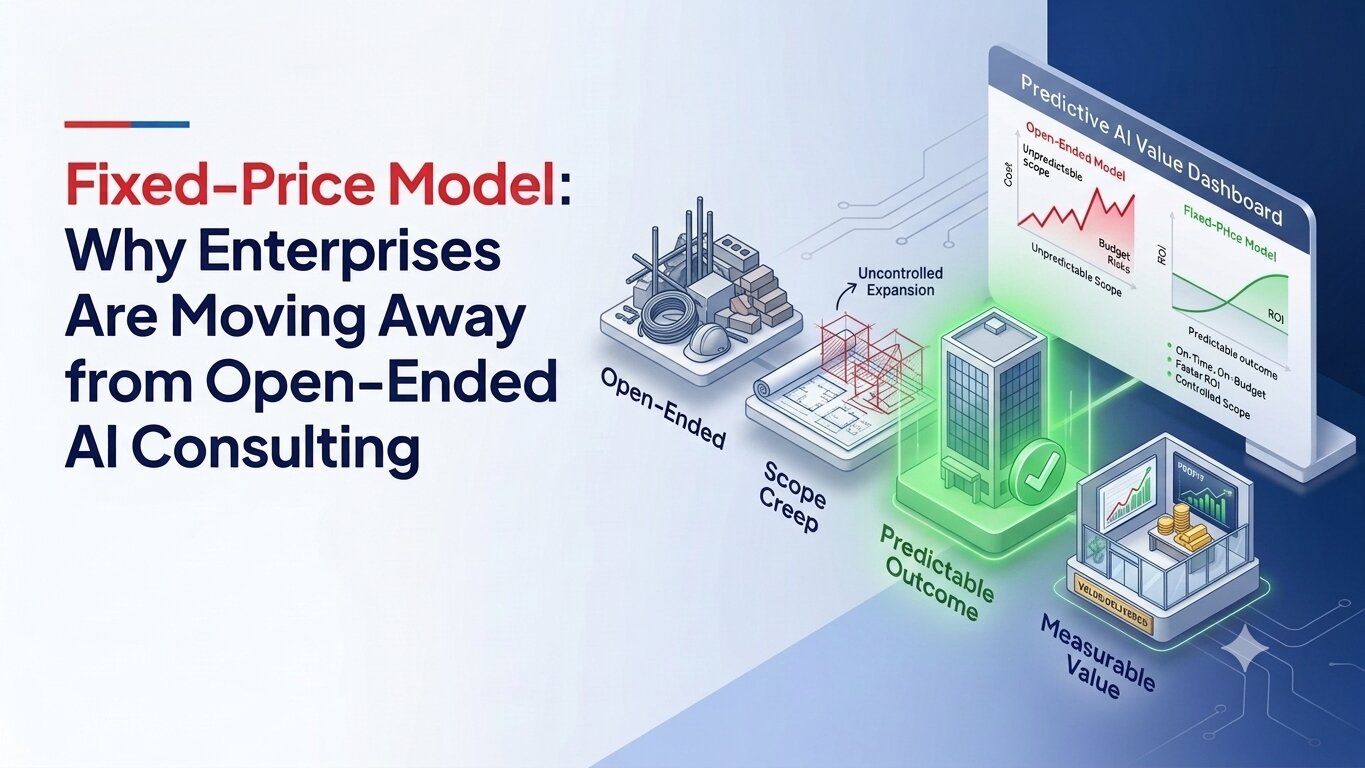
Fixed-Price Model: Why Enterprises Are Moving Away from Open-Ended AI Consulting


If you tried to budget an AI initiative around what the underlying model costs, September 2026 would have made that budget obsolete twice over. Five frontier model launches landed in ten days. One lab cancelled a planned price hike mid-cycle. Another is running a promotional rate it has already been said that customers will double by 2027. Token prices moved in both directions, sometimes for the same provider, within the same month.
That volatility is exactly why the fixed-price model is gaining ground over open-ended AI consulting, and why Airo Digital Labs built the agenTriniti package around it from the start.
Here’s what a single month of frontier pricing actually looked like:
Five labs, five different pricing strategies, inside the same ten-day window. None of that volatility is a one-off. It’s the operating condition enterprises are now building agents under.
It’s tempting to treat falling or shifting token prices as good news for AI budgets, and at the margin, it often is. But token cost was never the biggest line item in a serious enterprise AI deployment. The engineering work, integration, testing, monitoring, and ongoing fixes, is. Token pricing volatility just means that even the one number everyone assumed was stable now needs to be rebudgeted every quarter.
Open-ended, time-and-materials AI consulting compounds that problem instead of absorbing it. When the underlying model pricing shifts and the delivery contract is open-ended too, an enterprise is carrying two sources of budget uncertainty at once, with no way to separate “the model got more expensive” from “the project is taking longer than scoped.”
A fixed-price model doesn’t make token costs disappear. What it does is isolate them: the enterprise knows exactly what the delivery engagement costs, regardless of which way the underlying model market moves that quarter.
That protection has to hold across all three phases of agenTriniti℠, not just the initial build:
So, a model price change, a cancelled hike, or a promotional rate that doubles next year becomes Airo Digital Labs‘ problem to route around, not a renegotiation the client has to initiate.
It also forces a different kind of discipline on the delivery side. A vendor billing by the hour has limited incentive to make deployment efficient quickly. A vendor delivering at a fixed price has every incentive to get an agent into production-grade shape fast, the same testing and gating discipline covered in what it takes to ship production-grade agents, because the cost of extra iteration comes out of margin, not the client’s budget.
Fixed-price model is an engagement model where an enterprise pays a set price for an AI deployment rather than billing by time and materials, which isolates the client’s cost from ongoing shifts in underlying model token pricing.
Five frontier labs released new models inside ten days, and each one priced differently. Claude Opus 5.5 launched at $4 input and $20 output per million tokens, GPT-6 Astra at $10 and $50, and Gemini 3.8 Flash at a promotional $0.75 and $3.75 that Google says will double in 2027.
Not necessarily. In most serious deployments, tokens are a small slice of the total cost next to engineering, integration, and ongoing maintenance. So, when token prices swing, what you mostly get is budget uncertainty, not a smaller bill.
With open-ended, time-and-materials consulting, the client carries both scope overruns and any change in model pricing. With fixed-price delivery, the price is agreed up front, and the vendor takes on that volatility instead.
One fixed price covers all three agenTriniti℠ phases: Build, Manage, and Continuously Upgrade. That keeps the cost of deploying and running an enterprise AI agent predictable, whatever the model market does.
