Will Your Enterprise AI Agents Outlive Any One Model? What OpenAI’s Latest Launches Mean


Every time a major AI vendor announces a new generation of capabilities, the same question reaches enterprise technology teams: what does this change for us?
After OpenAI DevDay 2026 on September 29, there is another question worth asking. As enterprise AI agents become more capable and take on more responsibility, how should enterprises design the layer that sits between their business processes and the models powering those agents?
OpenAI announced more than 20 updates across ChatGPT, Codex, its models, and new ways of working with AI. Taken individually, these are product improvements. Taken together, they show how quickly enterprise AI is moving from conversational experiences toward agents that can interact with software, collaborate with teams, perform recurring tasks, and operate across connected applications.
For enterprise leaders, the opportunity is significant. So is the architectural question: if the model underneath an agent changes, can the agent and the business process it supports continue to operate?
This is where questions around AI vendor lock-in, AI agent governance, and model portability become important.
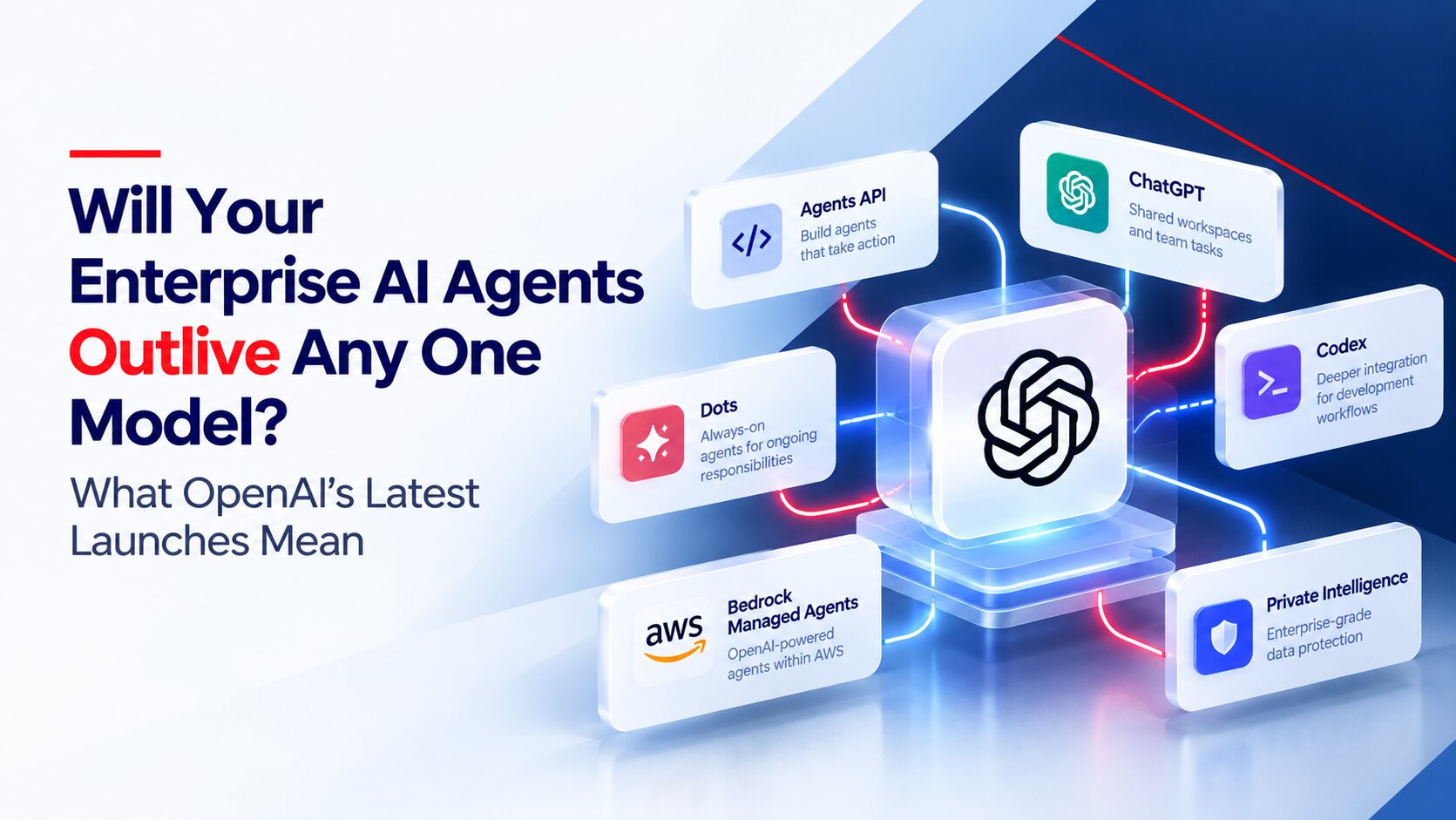
The full list is extensive. Several announcements are particularly relevant to enterprise AI strategies.
The direction is clear: enterprise AI agents are becoming more capable and more deeply integrated into the environments where business work happens.
That creates a new architectural consideration. The more responsibility an agent takes on, the more important it becomes to understand what sits around the model itself.
AI vendor lock-in is not unique to OpenAI, nor is it necessarily a reason to avoid a managed AI platform.
The same basic question has existed with cloud platforms, ERP systems, data platforms, and other foundational enterprise technologies. A platform can deliver significant value while also becoming deeply embedded in business processes over time.
AI agents add another dimension because they do more than store information or provide software functionality. They can make decisions, interact with applications, initiate workflows, and perform actions on behalf of people.
That means enterprises should consider three things before scaling agents into critical processes:
These questions do not imply that enterprises should avoid integrated platforms. They help determine which parts of an AI architecture should remain tightly integrated with a provider and where the enterprise may want greater portability and control.
OpenAI’s latest capabilities make a strong case for an integrated enterprise AI environment.
Agents API with computer use can simplify the development of agents that interact with software. Bedrock Managed Agents gives organizations an option to run OpenAI-powered agents within AWS. ChatGPT Space and team capabilities bring people and agents into shared working environments, while Private Intelligence addresses enterprise data-protection requirements.
For organizations already invested in OpenAI, these capabilities can reduce implementation friction and accelerate adoption.
The architectural question is therefore not “OpenAI or no OpenAI?”
It is whether the enterprise wants every layer of a particular agent deployment to depend on the same platform, or whether certain business-critical capabilities should remain independently governed.
For some workloads, an integrated platform may be the right answer. For others, particularly agents expected to operate for years across critical business processes, maintaining model portability may be more important.
Many enterprises can use both approaches.
agenTriniti℠, Airo’s enterprise AI agent lifecycle management platform, takes a model-agnostic approach.
The premise is straightforward: the model powering an enterprise agent should be a component of the architecture, not the definition of the agent itself.
agenTriniti℠ separates the agent lifecycle from the underlying model layer. This allows enterprises to evaluate and change the models powering their agents as requirements evolve, rather than treating every model change as a reason to redesign the entire agent lifecycle.
In practical terms, the agent’s business purpose, workflow, integrations, governance, and operational management remain part of the agent architecture while the underlying model can be evaluated independently.
This matters because model capabilities, pricing, performance, availability, and enterprise requirements will continue to change.
Portability has a price. A layer that works across several models cannot always use every feature a single provider offers, and each additional provider brings its own contracts and reviews to manage. For many business processes that is a fair trade. For workloads that depend on one provider’s newest capabilities, an integrated platform may be the better fit.
Where do your agents run, and who operates the infrastructure underneath them?
agenTriniti℠ provides the lifecycle and management layer for enterprise agents, while the underlying deployment environment and model can be treated as separate architectural components. This gives enterprises greater flexibility over how and where agents are operated.
Where does the record of what an agent did, and who approved it, live?
agenTriniti℠ incorporates agent governance into the lifecycle, including operational records around agent activity and human oversight. This gives enterprises a framework for tracking agent actions and approvals as part of the managed agent lifecycle rather than treating governance as a separate process.
What would it take to change the model provider underneath an agent that already works?
agenTriniti℠ is designed so that the underlying model can be changed without redefining the agent’s business purpose, workflow, or governance structure. A model change still takes work, because prompts, tool use, and outputs behave differently from one model to the next, and the agent should be tested again before it returns to production. The aim is to limit that effort to testing and tuning, with no rebuild of the agent. Enterprises can then evaluate another model when its capabilities, economics, or risk profile make it a better fit.
That is the practical distinction between model choice and agent architecture.
An enterprise agent is not finished when it is deployed.
As agents move into production, organizations need to monitor how they perform, manage changes, maintain governance, and respond to new business requirements and model capabilities.
agenTriniti℠ organizes this lifecycle around three stages:
Build
Create and deploy agents around defined enterprise processes and use cases.
Manage
Operate those agents with ongoing governance, monitoring, oversight, and performance management.
Continuously Upgrade
Improve agents as business requirements change and new AI models and capabilities become available.
This approach becomes increasingly important as enterprises move from individual agents to coordinated deployments across departments and business processes.
The objective is not to predict which model will dominate the market.
It is to ensure that the agents doing important enterprise work can evolve as the market changes.
Yes, with the right design and some discipline.
An enterprise AI agent can have a business purpose, workflow, integrations, governance requirements, and operational history that remain valuable even as the model underneath it changes.
That is the fundamental idea behind a model-agnostic approach.
The discipline is in the testing. Models differ in how they follow instructions, use tools, and format their outputs, so a model change should come with a fresh evaluation of the agent against the process it supports before it goes live.
The model may change because a new provider offers better reasoning, lower costs, stronger security characteristics, improved performance, or capabilities better suited to a particular workload.
The agent should not necessarily have to start from zero.
For enterprise leaders, that distinction can determine whether an AI deployment becomes a durable business capability or remains tied to the technology choices made at the time it was first built.
OpenAI DevDay 2026 demonstrates how quickly the enterprise AI agent landscape is expanding. Agents are moving closer to the systems where real business work happens, making the architecture around those agents as important as the models powering them.
The answer to the question in this article is that they can. Enterprise AI agents are more likely to outlive any one model when the architecture separates the agent lifecycle from the underlying model provider, and when each model change is tested before it goes live.
OpenAI can be an important part of that architecture. The broader strategic choice is how much flexibility, governance, and portability an enterprise wants around the agents it plans to operate for years.
That is the role agenTriniti℠ is designed to address through a model-agnostic lifecycle built around Build, Manage, and Continuously Upgrade.
What is an enterprise AI agent platform?
An enterprise AI agent platform provides the capabilities needed to build, deploy, operate, govern, monitor, and continuously improve AI agents used within business processes.
What is AI vendor lock-in?
AI vendor lock-in occurs when an organization’s agents, workflows, integrations, data, or operational processes become sufficiently dependent on a particular provider that changing platforms becomes difficult or costly.
Why does model independence matter for enterprise AI agents?
Model independence gives enterprises greater flexibility to evaluate models based on capabilities, cost, performance, security, and business requirements as the AI market evolves.
What is AI agent lifecycle management?
AI agent lifecycle management covers the ongoing process of building, deploying, monitoring, governing, optimizing, and upgrading AI agents throughout their operational life.
Should enterprises use only one AI model provider?
Not necessarily. An enterprise may choose a primary model provider while maintaining an architecture that allows it to evaluate or adopt other models when business requirements, economics, or technology change.
