Closing the Gap Between Selling a Home and Getting Paid – How Airo helped India’s largest Real Estate firm


Lodha sells homes faster than it can register them. Every week a file sits waiting on one missing document is a week the buyer’s bank does not pay. Airo Digital Labs built a Claude agent that works out what each open file is stuck on, every morning, and writes the chaser.
| Client | Lodha Developers (formerly Macrotech Developers) |
| Region | India, across MMR, Pune and Bengaluru |
| Industry | Residential real estate development |
| The problem | Homes were booked faster than the paperwork behind them could be closed. Hundreds of files sat open at once, each blocked on one small thing, and nobody found out until someone opened the file. |
| What Airo built | A Claude agent that reads every inbound document and message against each open file, works out what is actually blocking registration, and drafts the specific chaser to the specific person. Daily, across the whole pipeline. |
| Where it lands | Shorter booking-to-registration cycle, fewer registrations rejected at first attempt, more files per executive, and blocked files visible the next morning instead of three weeks later |
The sales floor was never the issue. The filing cabinet was.
Lodha has spent a decade building one of the strongest residential sales engines in the country. Pre-sales ran to ₹20,530 crore in FY26, with FY27 guidance of ₹24,000 crore, and a single quarter added five new projects across three cities with gross development value of ₹22,700 crore. Demand is not the constraint.
Cash conversion is. Collections came to 73.8% of pre-sales in FY26, and analysts covering the company named it the number to watch. Selling a home and being paid for it are separated by a chain of paperwork, and that chain was running on people.
The chain itself is dull, which is exactly why nobody had fixed it. A booking form becomes an allotment letter. That becomes an Agreement for Sale. Stamp duty gets paid, a sub-registrar appointment gets booked, and the agreement gets registered. Only then does the buyer’s lender release money. Where a home loan is involved, disbursement is tied to that registration, and banks hold back the final disbursement until it happens.
From agreement to registered deed usually takes 30 to 60 days. Very little of that is legal difficulty. Most of it is waiting. On a co-applicant’s PAN copy. On a name spelled three different ways across three documents. On a bank sanction letter that landed in someone’s inbox and never got filed. On a stamp duty figure nobody recalculated after the state revised its rates.
Getting the duty wrong costs real money. Registration can be rejected or challenged later, and underpayment attracts a penalty of anywhere between 2% and 200% of the shortfall depending on the state. States revise the rules often. Several charge women buyers a lower rate, which makes the correct figure a per-buyer calculation rather than a project-level constant.
The CRM operations team knew all of this perfectly well. What they could not do was see it. With several hundred files open at any moment, the only way to find out a file was blocked was to open it. Files surfaced when somebody chased them, and somebody chased them when a manager asked. A file could sit still for three weeks and nothing in the system would say a word.
Lodha did not need faster document generation. It had templates. It needed something that knew, every morning, which files had moved, which had not, and what each stalled one was waiting for.
A Claude agent that runs the pipeline rather than the paperwork. It does four things, and the fourth is the one that matters.
It drafts. It drafts the Agreement for Sale from booking data against the project’s approved template and annexures: unit, carpet area, parking, payment plan, possession date, amenities schedule. This is the least interesting part of the system and Airo scoped it that way on purpose.
It checks whether a file is actually ready before anyone books an appointment. Are all applicants’ identity documents on file? Do the name spellings agree across the booking form, the ID and the lender’s sanction letter? Is the co-applicant confirmed? Has the lender NOC arrived? Is the project registration number current?
It works out the stamp duty from a rate table Lodha maintains, applies it to the right state, buyer category and agreement value, flags where the assessed market value runs above the agreement value, and shows its arithmetic. It is not allowed to recall a rate from memory. That was a design decision, not an oversight, and it is the single most important guardrail in the system.
Then it reads the inbox and works out what each file is stuck on. This is the agent.
Every day, documents and messages arrive that relate to open files without announcing which ones. A lender’s sanction letter as a PDF attachment. A channel partner forwarding a scanned ID with no covering note. A buyer replying to a three-week-old thread to say their co-applicant is travelling. A relationship manager asking a question that, read properly, means the file cannot move.
The agent reads all of it, matches each item to the file it belongs to, updates what that file now has, and works out what it still lacks. For every file that is genuinely blocked, it drafts the next message to the buyer, the channel partner or the bank, naming the one thing outstanding.
That is the difference between a reminder system and this. “Your file is pending” gets ignored. “We need your co-applicant’s ID proof; the copy you sent on the 14th was cropped and the number is unreadable” gets actioned.
A CRM executive reviews and sends. What changes for them is that the day starts with a ranked list of what needs pushing, instead of a queue they have to open file by file to understand.
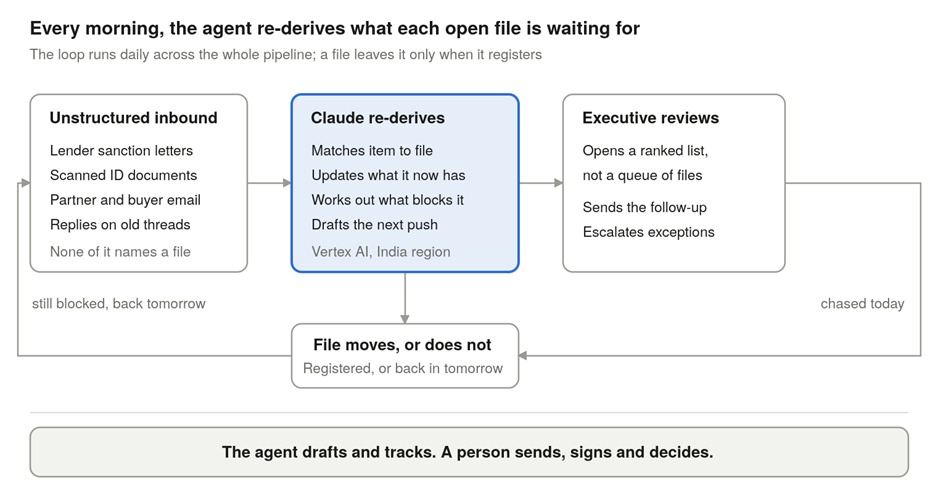
The loop is the part that matters. A one-way pipeline handles a file once and passes it on. This runs over every open file every day, so a file that stalls gets picked up the next morning rather than whenever somebody happens to ask.
What the agent is not allowed to do mattered as much to Lodha’s legal and finance teams as what it does.
The pattern holds throughout: the agent does the reading and the tracking, and people keep every act that carries legal or commercial weight.
The hard part is not writing text. It is reading text nobody formatted for a machine. A sanction letter, a scanned ID page forwarded without a note, a one-line reply on a month-old thread. None of it is structured, none of it names the file it belongs to, and the meaning often sits in what was left unsaid. Claude holds the whole file state in context and reasons about what a new item changes, rather than matching keywords.
Consistency is a compliance property here, not a style preference. The same readiness rule has to give the same verdict on the four-hundredth file as on the first, whatever the queue looks like that week. A registered agreement is the instrument a buyer’s ownership rests on, so variation between operators is a defect.
Legal signed off because every conclusion cites the document behind it. In this workflow, an answer you cannot trace is unusable even when it is correct.
On hosting: buyer identity documents, income proofs and lender correspondence cannot leave India. The agent runs on Claude through Google Cloud Vertex AI on an India regional endpoint, where data and processing stay inside that boundary. Anthropic’s regional compliance covers data residency across Asia-Pacific including India, on Bedrock, Vertex and Foundry, so the choice came down to Lodha’s existing estate rather than what was available. Google was already a vendor of record and Workspace was already the collaboration layer, which put the agent inside the environment the operations team works in every day.
Anthropic launched the Claude Partner Network globally in March 2026, and India posted among the highest registration numbers in the world. Airo Digital Labs delivered this through that network. The model supplies the reading. What made it a production system was mapping the readiness rules the operations team carried in their heads, wiring the agent into the CRM without disturbing a live sales pipeline, and drawing the guardrails tightly enough that legal would sign.
expected reduction in booking-to-registration time
estimated working capital released, one-time
expected reduction in first-pass registration rejections
faster detection of a blocked file
Success meant narrowing the gap between selling a home and being paid for it. Based on how the agent is designed and where the client’s files stall today, that is the outcome Airo and the client expect. The figures below are projections across the open-file pipeline, and they come mostly from removing dead time, not from any single step running faster.
