How Jio Credit Is Scaling Lending Without Scaling Headcount


Jio Credit grew its loan book 163% in a year. Its costs grew faster. A lot of that gap sits in one place: people reading documents. Airo Digital Labs built a Claude agent to do the reading, so the credit team can spend its time deciding instead.
| Client | Jio Financial Services (Jio Credit, its NBFC lending arm) |
| Region | India |
| Industry | Financial services, secured retail and SME lending |
| The problem | Disbursements were growing faster than the credit operations team could. Every mortgage and SME file arrived as a stack of documents that disagreed with each other, and a person had to work out where. |
| What Airo built | Two document agents running on Claude, hosted on Amazon Bedrock inside India. They read a full credit file, reconcile it, and hand the underwriter a note listing what is wrong and which page it is on. |
| Where it lands | Shorter file preparation, more files per underwriter without hiring, problems caught before sanction instead of after disbursement, and an audit trail that writes itself |
Jio Financial Services has the kind of problem most lenders would like to have.
Jio Credit took assets under management from ₹11,665 crore to ₹30,667 crore in twelve months. Quarterly disbursements went from ₹4,127 crore to ₹11,252 crore. The group’s app crossed 25 million users across more than 19,000 PIN codes, selling around 34,000 products a day.
The cost of running all that grew faster than the book. Quarterly expenses went from ₹254 crore to ₹991 crore. Staff costs went from ₹64 crore to ₹152 crore. Disbursements grew 2.7 times; expenses grew 3.9 times. Management flagged operating leverage as the thing to watch, which is a polite way of saying the company cannot keep buying growth with headcount.
Two portfolios carry nearly the whole book. Mortgages, meaning home loans and loan against property, are 45.4% of AUM. Corporate and SME lending is 44.2%. Both of them run on paper.
A mortgage file is a title chain, an encumbrance certificate, a builder approval, an occupancy certificate, a legal opinion, a technical valuation, tax returns, bank statements and employer proofs. Usually scanned. Often in a regional language. Regularly inconsistent with each other. An SME file is GST returns, audited financials, a year of bank statements and a pile of vendor invoices.
Credit staff spend their days reconciling all of this by hand. The work takes real judgement. Whether a gap in a title chain matters. Whether two spellings are the same person. Whether the valuer’s measured area contradicts the sale agreement. None of that is clerical. But it was happening at the speed of human reading, and human reading does not scale 2.7 times in a year.
You could see the effect in three places. Files stalled at legal and property verification, which is where mortgage files most often get stuck. Applicants dropped out, and digital lending abandonment often runs past 60%, usually because verification takes too long and there are too many manual steps. And the cost of putting a loan on the books kept rising with volume rather than falling against it.
JFS had already said publicly that it wants to be an AI-native institution. It did not need persuading. It needed its two biggest credit workflows rebuilt so that growing stopped costing proportionally more. It brought in Airo Digital Labs.
A mortgage file is not one document with fields to pull out. It is fifteen to forty documents that are supposed to agree, and the whole value of reading them is finding where they do not. JFS had already tried OCR. It read the documents fine. It could not think across them.
The agent takes the full file and produces a credit note. It checks whether the applicant’s name on the sale deed matches the tax return, the bank statement and the KYC record, allowing for the initials, honorifics and spelling variants that are completely normal in Indian paperwork. It checks whether the property address agrees across the agreement, the tax receipt and the technical report. It checks whether the title chain runs continuously or skips a conveyance, and whether the encumbrance certificate actually covers the period policy requires.
Then it looks for contradictions. Does the valuer’s measured area match the sale agreement? Does declared income line up with the credits in the bank statement? Did the legal opinion attach a condition that nobody has acted on?
Finally it applies JFS’s own credit policy and sorts what it found: waivable at branch level, needs credit committee, or a hard stop.
What comes out is a credit note the underwriter can act on. The recommendation is at the top. Below it, the exceptions run in order of severity, each one citing the document and page it came from. The underwriter opens the file already knowing where to look.
The agent never sanctions anything. It prepares. Because every finding cites a page, an underwriter, an auditor or a regulator can trace any conclusion back to the document that produced it. The model reads; the human decides.
The mortgage agent is about accuracy. This one is about speed. Corporate and SME lending is 44.2% of AUM, in a market where a borrower who waits a week has usually gone somewhere else.
An SME credit pack gets assembled rather than submitted. An analyst pulls GST returns, spreads a year of bank statements line by line, reads the audited financials, cross-checks vendor invoices for supply chain exposure, then writes it up. The slow part is not the credit decision. It is the four to six hours of assembly before anyone gets to make one.
The agent classifies every transaction in the statements, separates genuine business inflows from money circling between related accounts, spots cheque returns and the pattern behind them, and describes the seasonality of the business rather than just its average balance. It reads GST filings against declared turnover and names the specific periods where they diverge. It reads across invoices, statements and filings to surface customer concentration and related party flows that no single-document review would catch. Then it drafts the memo in JFS’s own template, with every figure linked back to its source.
The analyst stops assembling and starts adjudicating. Capacity per analyst goes up without hiring, which is the direct answer to a cost base growing 3.9 times against disbursements growing 2.7 times.
Between them, the two agents cover 89.6% of Jio Credit’s lending book. That was the sequencing decision: not the most interesting use case, the two biggest ones.
Credit file pipeline, four stages, human decision at the end
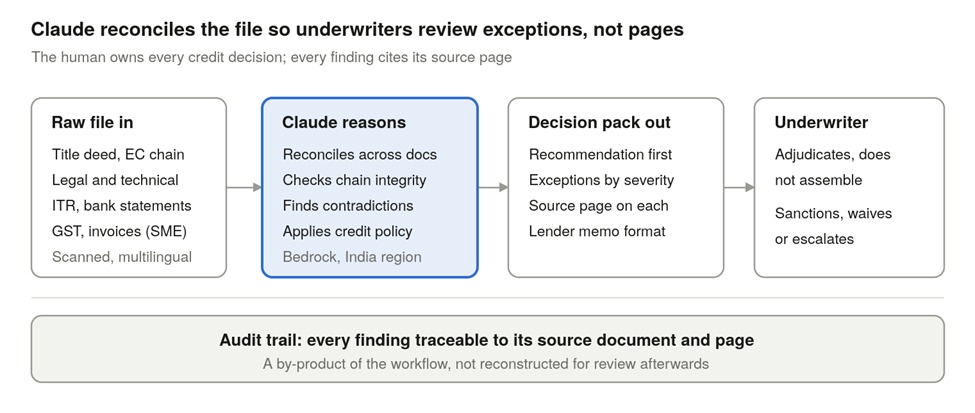
Both agents run the same shape. What changes between mortgages and SME is the document set and the policy applied, not the architecture. That is why the second one took a fraction of the build time of the first.
Data residency settled the architecture before anything else did. An RBI-regulated lender cannot send borrower KYC, income documents and property papers out of the country. That ruled out most options until Anthropic made Claude available with in-country inference in India through Amazon Bedrock, with requests processed on servers inside India. Anthropic’s India managing director Irina Ghose called it a turning point for enterprise AI in the country, and AWS India and South Asia president Sandeep Dutta framed it as letting enterprises adopt frontier AI at scale. Without that endpoint this deployment would not have happened on the timeline it did.
As for why Claude does the reading: the job is not extraction. It is holding forty documents in mind at once and noticing that two of them disagree. Claude keeps context across long, messy source material instead of processing each document alone.
Consistency matters here more than it sounds. Credit policy is a set of rules that has to be applied the same way every time, with the same thresholds and the same escalation. Variation between officers is a regulatory finding, not a quality niggle.
And every conclusion cites its source. In a regulated control environment, an answer you cannot trace is unusable even when it happens to be right.
One more practical reason: the same model family powers Claude Code for the engineers building and maintaining these pipelines. One AI foundation means one governance framework rather than several.
Anthropic launched the Claude Partner Network globally in March 2026, and India posted among the highest registration numbers anywhere. Airo Digital Labs delivered this work through that network. The model supplies the reading. The operating model, the governance framework and the delivery discipline around it are what turned capability into a system JFS could actually run.
expected reduction in credit file preparation time
expected increase in files handled per underwriter
estimated savings in the first six months
lending book covered
The test was never whether the agents could read a credit file. It was whether cost-to-originate would start falling as volume rose, instead of climbing alongside it. Based on how the two agents are designed and how the client’s credit teams work today, that is the outcome Airo and the client expect. The figures below are projections across the mortgage and SME portfolios, which together make up roughly 90% of the lending book.
