Build, Manage, Continuously Upgrade: Why Anthropic’s Own Enterprise Roadmap Validates the agenTriniti Model


Every enterprise AI vendor eventually runs into the same problem: getting an AI tool into people’s hands is the easy part. Knowing what happened after that, what it’s actually being used for, what it costs, and where it’s quietly failing, is the part almost nobody plans for.
Anthropic’s own product roadmap over the past few months is a useful case study, because it shows an AI-first company discovering, in real time, that deployment isn’t the finish line. It’s the starting point for a lifecycle. That’s the same approach to AI use case lifecycle management that agenTriniti℠ Package was built around: Build, Manage, Continuously Upgrade.
In July, Anthropic added usage and cost analytics to the Claude Enterprise admin console: spend and activity broken out by group, by user, alongside the artifacts people created and which skills and connectors they used. Useful, but still a dashboard of numbers: sessions, dollars, counts.
Then in September, Anthropic shipped something structurally different: Smart Reports, a beta feature that has Claude read a sample of an organization’s own transcripts and write up what actually happened inside them. Instead of just showing that a team spent a certain amount on a certain number of sessions, it groups the work into workstreams, attaches cost to each group, and, critically, surfaces friction: connector failures, rework loops, tool errors, and sessions that never produced anything useful. It also flags the patterns a team keeps reinventing by hand, so they can be packaged into a shared, reusable skill instead.
That’s not a usage report. That’s a management layer.
Most enterprise AI initiatives are still funded and staffed like a launch: pick a use case, build the agent or workflow, ship it, move on to the next project. The assumption baked into that approach is that once something is deployed, it basically runs itself.
Anthropic’s own sequencing argues against that assumption. The company that builds the model needed two separate product releases, usage analytics, then a reporting layer that explains cost, friction, and reuse opportunities, before enterprises had a real way to answer the question “is this actually working, and where is it breaking down?” If the model vendor itself treats post-deployment visibility as a distinct, ongoing product problem rather than a footnote, that’s a strong signal that the enterprises deploying on top of it should too.
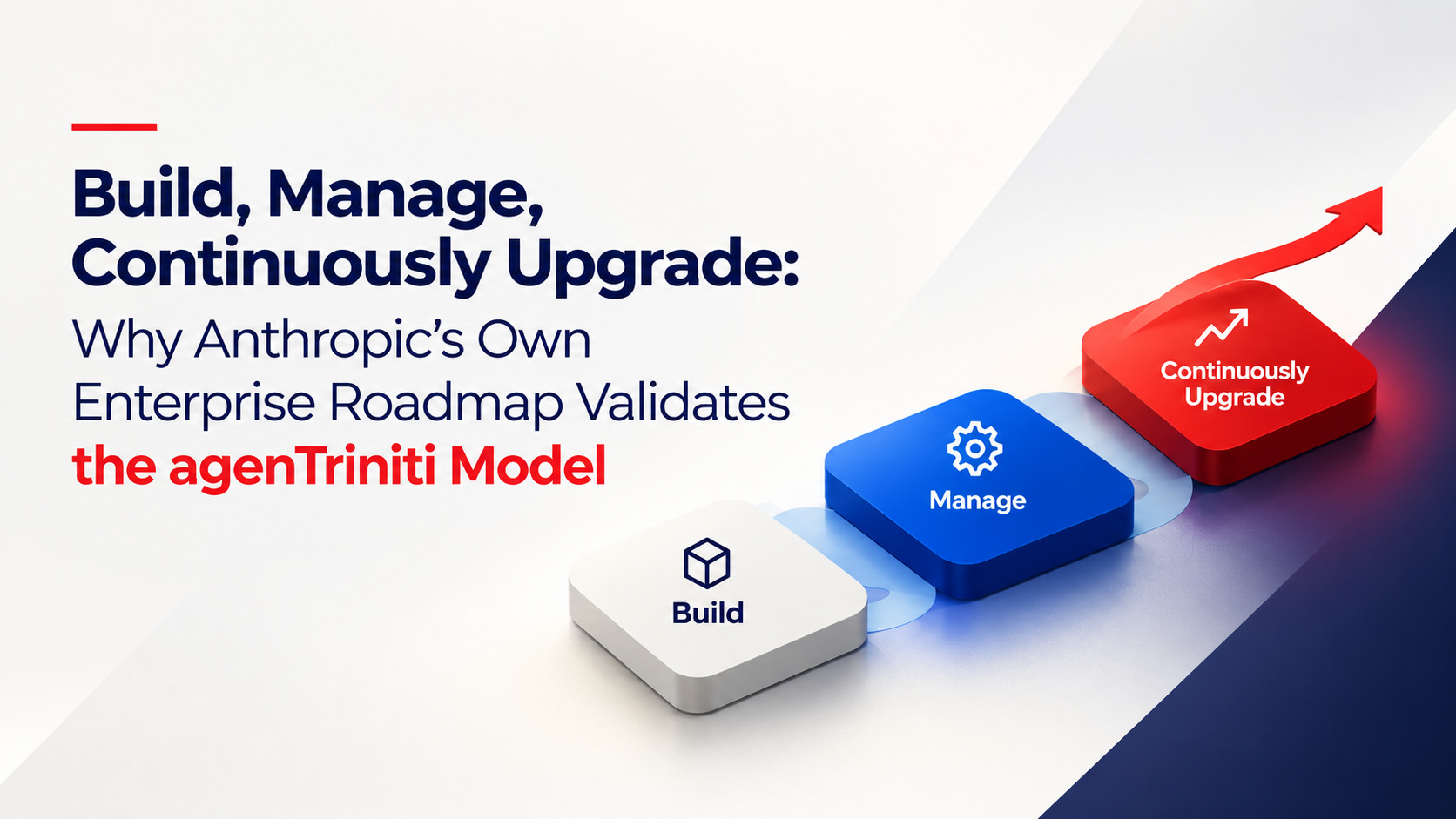
This is precisely the gap agenTriniti℠ Package was designed to close, structurally rather than as an afterthought:
Build covers the part every vendor optimizes for: standing up production-grade agents against a defined use case.
Manage is the layer most deployments skip: ongoing visibility into what the agents are actually doing, what they cost by workstream, and where friction is quietly eating the ROI.
Continuously Upgrade closes the loop: turning what Manage surfaces (a repeated manual pattern, a recurring tool failure, a workstream nobody’s optimized) into the next build cycle, instead of letting it sit in a report nobody acts on.
A tool that identifies friction still leaves the harder question unanswered: who owns fixing it, and on what cadence? Smart Reports can tell an enterprise that a particular workstream is generating repeated connector failures, or that a task is being reinvented session after session in a way that could become a shared skill. It can’t restructure the agent, rebuild the integration, or decide which fixes are worth prioritizing against everything else in the roadmap.
That’s the operational gap agenTriniti’s fixed-pricing model is built to close, not by replacing tools like Smart Reports, but by giving enterprises a standing team and a defined process to act on exactly what that kind of visibility surfaces, on a continuous basis rather than as a one-off project.
Anthropic building this capability into its own enterprise product is a good sign for the category: it means the vendor supplying the model now agrees that manage-and-upgrade isn’t optional. What it doesn’t do is supply the team, the process, or the accountability to close the loop. That’s still a separate build, and it’s the one Airolabs delivers through agenTriniti Package.
What is AI use case lifecycle management?
AI use case lifecycle management is the practice of overseeing an enterprise AI use case from the moment it is built through ongoing monitoring, cost tracking, and upgrades, instead of treating deployment as the finish line.
What does “Build, Manage, Continuously Upgrade” mean in enterprise AI?
It’s a lifecycle model for enterprise AI deployment: Build covers standing up production-grade agents for a defined use case, Manage covers ongoing visibility into what those agents are doing and costing, and Continuously Upgrade covers turning what Manage surfaces into the next build cycle.
What did Anthropic actually change in its Claude Enterprise roadmap in 2026?
In July 2026, Anthropic added usage and cost analytics to the Claude Enterprise admin console.
In September 2026, it added Smart Reports, a beta feature that analyzes transcripts to surface cost by workstream, recurring friction, and reuse candidates.
Why does Anthropic’s roadmap matter to companies that aren’t Anthropic?
Because the company building the underlying model needed two separate product layers before enterprises could see whether their AI usage was actually working. That’s evidence that post-deployment management is a distinct, ongoing need, not an edge case specific to one vendor.
Does a tool like Smart Reports replace the need for a managed AI framework?
No. Diagnostic tools can surface friction, cost, and reuse opportunities, but they don’t restructure agents, rebuild integrations, or decide which fixes to prioritize. That still requires a standing team and process.
What is agenTriniti℠ Package?
agenTriniti℠ Package is Airo Digital Labs’ AI Use Case lifecycle management system for deploying production-grade enterprise AI agents at fixed pricing, structured around three phases: Build, Manage, and Continuously Upgrade.
